Monday, April 06, 2009

Morningstar: A 401(k) Death Star?

I received a letter from Morningstar today. Danger I find within it! The degree to which risk in the stock market can be downplayed these days is frightening. Here's what the letter said...
Dear Fellow Investor,

The year I started at Morningstar, interest rates were spiking and the NAFTA-inspired Mexican equity bubble became a panic. That was 1994. Since then, we've seen a Russian default mess, an Asian meltdown, the bursting of the Internet bubble, the attacks of 9/11, two wars, the subprime housing collapse, and much more than you care to read here.

In spite of all that, we still managed to experience a huge bull market, and most of the top money managers and investment firms are still standing.

What's the secret? Buy-and-hold investing still works, while trendier strategies have their moments and go bust. This down market is a great time to invest with good managers--provided you're in it for the long term. You just have to know where to put your money.

The stock market has gone nowhere for more than ten years. So, I am not at all clear on this "huge bull market" experienced over the interim.

Just very briefly ... "invest with good managers" ... be "in it for the long term" ... "know where to put your money" ... your response should be duh, duh, and duh. No kidding!

Of course "buy-and-hold investing" still works! However, I would challenge the author to show me a portfolio of stocks (out of the thousands traded) — a portfolio (or fund) that's widely available to 401(k) investors — whose performance over the past ten years outmatched the strategy I advocate.

Diversify your 401(k) investments in fund choices 100% committed to the U.S. stock market, but only when your risk of loss is low. Otherwise, move your 401(k) savings into a safe money-market fund. Plan "A" and Plan "B" — very simple.

Here's my record ever since I began using this strategy (and broadcasting my position)...
  • January 2000: Moved 401(k) savings to money-market fund
  • February 2003: Switched out of money-market fund and into funds 100% invested in the U.S. stock market
  • May 2008: Moved back into money-market fund
  • November 2008: Switched back into funds 100% invested in the U.S. stock market (largely a short-term, speculative play)

So, what's the risk of loss in the stock market right now?

Believe it or not, for the moment it is slight. That's not to say, however, there's no reason to be concerned and alert.
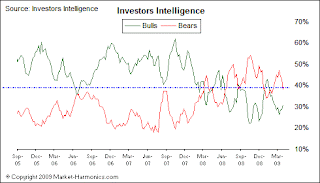


The consensus opinion of investment newsletter writers is no "be all, end all" indicator. In other words, widespread bearishness does not guarantee the stock market will move higher. Yet it does increase the odds. (Since most money managers fail to outperform the S&P 500, you can look at investment newsletter writer sentiment as a "contrary indicator." Generally speaking, if they're too bullish, watch out for a falling stock market; if they're extraordinarily bearish, stocks could pop.)

As for supposing the stock market's long-term fortunes look bright, all because there is a ton of bearishness among investment newsletter writers, just look at last year's record. The message is clear. The stock market can fall hard even amidst sentiment typical at bottoms. Like I said, this is no "be all, end all" indicator.

And don't lose sight of the fact all major stock indexes currently trade below their respective 200-day moving averages. There's good reason to remain concerned about the future here.

For now I agree with Morningstar's positive view. However sometime in the not-too-distant future I believe their bent might prove dangerous to most investors.

Risk should be a concern of every 401(k) investor, particularly in light of the fact that, when it comes to your retirement time is of the essence. You simply cannot afford taking big losses.

Saturday, November 22, 2008

Get Up from the School of Hard Knocks

401(k) Risk ManagementThis is a true story.

I received a phone call one extraordinary Friday evening. It was October 16, 1987. An associate, a politically-connected friend, had news I should hear.

The stock market, he said, would crash on Monday, October 19th! And CRASH it did.

Now, let me ask you this...

Why did I find it so hard to believe his dire prediction? Why did I not see the crash coming myself? Friday, October 16, 1987 — the day my friend called — was the worst day in an already bad month up to that point. Then came a shock on Monday, October 19, 1987: the Greatest Stock Market Crash of all time ... just as my friend said it would!

Why did I doubt his authority? Why did his claim seem too bold?

My disbelief was all the more surprising, because I had been telling others several months earlier that I, too, thought a stock market crash was possible. I was quite aware of the risk.

Are you wondering what is the point of this story?

Simply that skepticism is a sentiment to which we are all inclined. Yet fear of the unknown can be a healthy thing when we are driven to raise certainty in our decision-making ability.

Now, sometimes we believe we are living in extraordinary times. But are we ever really? Of course, yes, in some ways it is true. But for the most part life is the same as it ever was. People don't change all that much from one generation to the next.

Those who thrive in good times and bad learn to help themselves. Theirs is power to manage risk and get in front of opportunity. Having developed both confidence to act and conviction to withstand bumps in the road, these are people who know how patience pays.

Those who avoid risk like the plague all have something in common. They take action to secure their well-being.

Is your 401(k) back in the market?

It really is so simple. Sound reason alone can help you overcome natural doubt.

Sunday, June 15, 2008

Make 401(k) Safety Priority #1

Safe 401(k) Investment ManagementWay back in the early 1980s I met a rare coin dealer who shared his investment philosophy. The wisdom he shared I will never forget.

The first thing you should consider whenever you make an investment is how much you might lose.

Not win. Rather how much you might lose.

So, what's your risk investing your 401(k) in the stock market? Developing some tiny sense about this risk will make investing a lot safer for you ... and put you in line to explode your 401(k)'s growth with relative ease, now until forever.

You can stop reading right now if you believe risk in the stock market is some dark mystery whose threat cannot be estimated to any useful degree. Go listen to the glorified salesmen who pitch the balanced, diversified approach to investing. They'll have you sacking 14% of your pay into your 401(k), spreading your savings across the various financial choices you have available. They'll say you will be managing your risk.

But will you?

The one thing you must know about investing your 401(k) is how to exercise its fullest, safest power. This only requires you understand the stock market, because the stock market is where the money is at. Simply put, know how to identify when your risk of loss investing in stocks is elevated.

Let me ask you. Do you suppose this risk will be any different when you're 73?

Of course not. So, if you learn how to assess risk in the stock market, you're good for life. You'll never need to learn another thing about managing your 401(k).

Sometimes risk in the stock market is low. When? When most people believe the stock market is a lousy investment.

Sometimes risk in the stock market is high. When? You guessed it! When most people believe the stock market is the place to be.

Actually, it's a bit more complicated. But you get the idea.

This has little to do with calling tops and bottoms in the stock market. Indeed, back in January 2000 I was sounding the alarm to family and friends. Yet it took some months before the stock market turned south. I never lost confidence it would. Having been developing my analytical acumen since 1984, I knew risk in the stock market had become elevated.

Now, had you no sense of history and the nature of risk in the stock market, you might have doubted the threat stocks were facing when I sounded the alarm back in January 2000. I will never forget one friend telling me, "Where else am I going to put my money?" Captured by the allure of a stock market that had risen 20% annually for five straight years (1995-1999) — something unprecedented in U.S. stock market history — my friend was the best evidence there ever was that, risk in the stock market was astronomical.

Assessing risk is not rocket science. In fact, it's easy. With this power you can...
  • Beat 90% of financial pros
  • Save less and make more money
  • Retire sooner
  • Never worry about going broke in retirement

What more could you ask for?

There's just one thing you need wrap your brain around. Since the stock market is where the money is at, you must know when to fear the risk of suffering huge losses investing in stocks. Do this and odds increase astronomically you will enjoy a bright, financial future.

Knowing when to fear risk investing your 401(k) in stocks is ground already covered here. If this takes you more than five minutes a month, then you might be worrying too much.

Saturday, May 10, 2008

Timely 401(k) Investment Advice

Timely 401(k) Investment AdviceI don't care how old you are. A 70% chance the stock market could fall 25% or more means you are looking at the face of risk, not opportunity. Thus, risk averse 401(k) investors should have little, if any, of their accumulated savings exposed to the stock market. Switching to a safe money market alternative should be a no-brainer.

This, I believe, is both how to stay on track to retiring when you want (if not sooner) and forever keeping your net-worth growing at a pace faster than inflation. This is how to defend the purchasing power of your savings...

[More at the Risk Averse Alert]

Saturday, April 07, 2007

Weird (But Good) 401(k) Investment Advice

If ever the earth shakes Hollywood, California to the ground...

You get yourself in cash as fast as you can.

Do you realize how very important this city is to everything that's American? If ever Hollywood is hindered from producing its wares, America might be constrained from producing its wares.

I am talking about the I.O.U.

Has anyone else thought of this ... within the context of our highly leveraged, global village?

There's a mountain of debt whose servicing needs a captive audience for bombarding messages about what to buy. After all, sales mean financial obligations can be, first, met, and second, extended further.

Truth is, the name of the game with Structured Finance is INFLATE OR DIE.

Any serious challenge to this means Game Over. A collapse of sales message production (not to mention other mindless diversions) might represent a very serious threat indeed.

Look, if the place were not geologically active, I probably would not mention this at all.

Bottom line — earthquake or not — the ground upon which we stand is being made increasingly more unstable with each passing day's unchecked greed gone wild. Reputable men defend this arrangement as though nothing were amiss, because momentary ecstasy makes even a whore an otherwise good man's lover.

Her name is Structured Finance, and her "goodness" goes unquestioned... so long as she keeps putting out.